
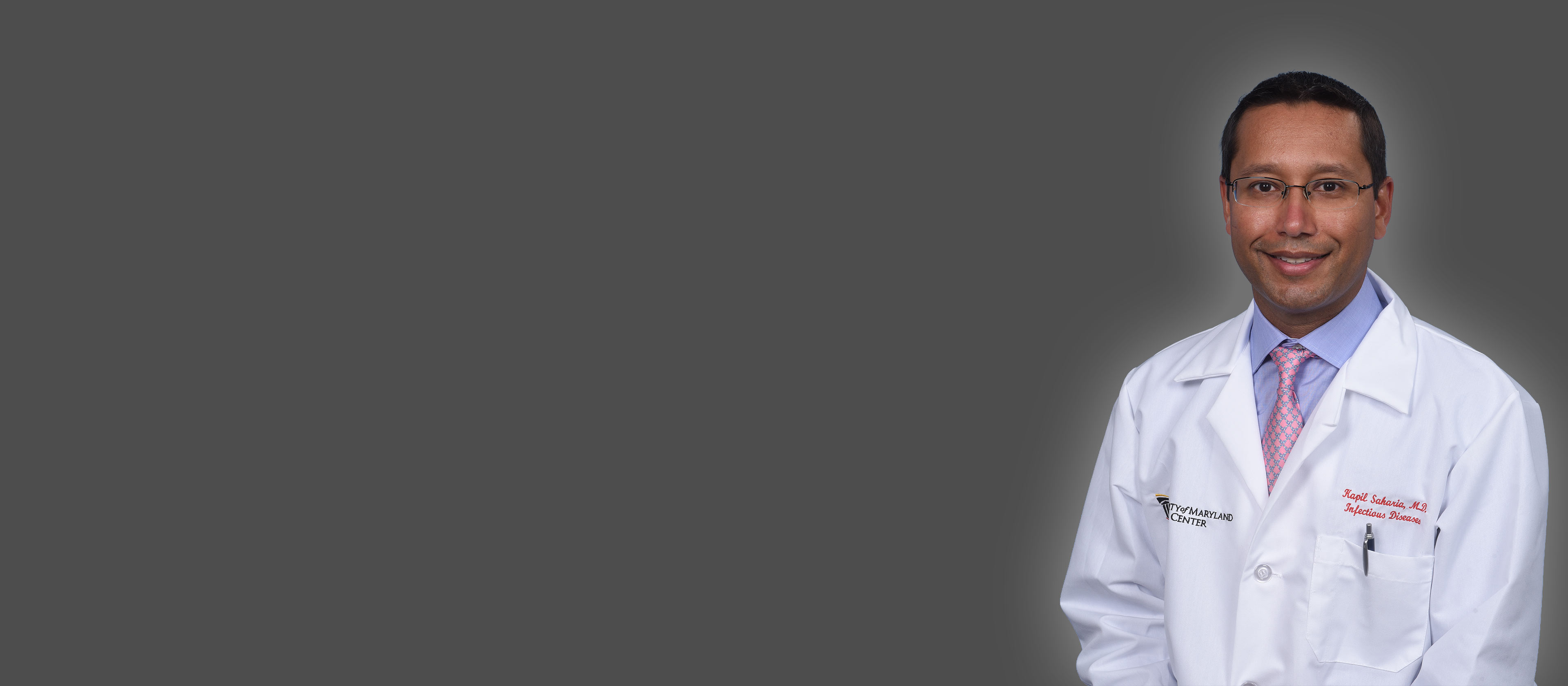
Kapil K. Saharia, MD, MPH
- Academic Title: Associate Professor
- Primary Appointment: Medicine
- Additional Title: Associate Professor of Medicine
- Email: ksaharia@ihv.umaryland.edu
- Location: 725 West Lombard Street Baltimore, MD 21201
- Phone (Primary): 410-706-2049
- Phone (Secondary): 410-328-9102
- Fax: 410-328-9106
Education and Training
Bachelor of Arts (B.A): Biology and English, The Johns Hopkins University, Baltimore, MD
Master's in Public Health (M.P.H): Public Health Leadership, University of North Carolina School of Public Health, Chapel Hill, NC
Doctor of Medicine (M.D): Duke University School of Medicine, Durham, NC
Residency: Internal Medicine/Pediatrics, Yale-New Haven Hospital, New Haven, CT
Fellowship: Infectious Diseases, University of Maryland Medical Center, Baltimore, MD
Post-Doctoral Fellowship: Immunology Laboratory, Vaccine Research Center, National Institutes of Health, Bethesda, MD
Biosketch
Dr. Kapil Saharia received his medical degree from Duke University School of Medicine and completed his combined Internal Medicine-Pediatrics residency at Yale-New Haven Hospital, where he served as Chief Resident during his fourth year. He subsequently completed a fellowship in Infectious Diseases at the University of Maryland Medical Center before joining the Immunology Laboratory at the National Institutes of Health (NIH) Vaccine Research Center as a postdoctoral fellow under the mentorship of Dr. Richard Koup. His research focused on characterizing the phenotypic and functional properties of Mycobacterium tuberculosis–specific CD4+ T cells using multiparameter flow cytometry and intracellular cytokine staining to distinguish stages of tuberculosis infection.
In 2012, Dr. Saharia joined the Division of Infectious Diseases at University of Maryland School of Medicine and the Institute of Human Virology, where he currently serves as Associate Professor of Medicine and Chief of Transplant Infectious Diseases, a position he has held since 2017. His clinical practice focuses on the prevention, diagnosis, and management of infectious complications in pre- and post-transplant solid organ recipients, patients receiving mechanical circulatory support, and people living with HIV.
In his leadership role, he has advanced clinical care through initiatives to improve infectious disease surveillance in solid organ transplant recipients, particularly for Cytomegalovirus (CMV) and Epstein-Barr virus (EBV) infection. In 2019, he developed a protocol for the use of hepatitis C virus nucleic acid testing–positive (HCV NAT+) donor organs in HCV-negative recipients, supporting the safe utilization of these organs and expanding the donor pool for transplantation.
Dr. Saharia’s research interests include infectious complications and outcomes following solid organ transplantation, vaccine immunogenicity and efficacy in transplant recipients, and the clinical utility of novel diagnostic assays to improve the diagnosis and management of infections in immunocompromised patients. He developed an infectious disease surveillance program and directed the management of infectious complications for the first two porcine-to-human cardiac xenotransplants ever performed worldwide at the University of Maryland Medical Center. He has served as a site co-investigator or principal investigator for several NIH-sponsored and industry-sponsored clinical trials.
Research/Clinical Keywords
CMV, vaccine immunogenicity, clinical trials, diagnostic stewardship, solid organ transplant
Highlighted Publications
Charles DW, Lee S, Charya A, Riggs J, Reed RM, Eberlein M, Saharia KK. Active surveillance and antimicrobial prophylaxis to prevent hyperammonemia syndrome in lung transplant recipients: A single center cohort study. JHLT Open. 2025 Oct 1;10:100403. doi: 10.1016/j.jhlto.2025.100403. PMID: 41143098; PMCID: PMC12547200.
Griffith BP, Grazioli A, Singh AK, Tully A, Galindo J, Saharia KK, Shah A, Strauss ER, Odonkor PN, Williams B, Silverman HJ, Burke A, Drachenberg CB, Wells CL, Dickfeld T, Hong SN, Hicks AJ 3rd, Ananthram M, Gupta A, Christenson RH, Tamburro L, Zhang T, Hershfeld A, Lewis B, Feller ED, Kuravi K, Sorrells L, Morgand E, Mezine F, Goutaudier V, Rothblatt M, Lau CL, Taylor B, Perrin S, Loupy A, Ayares D, Mohiuddin MM. Transplantation of a genetically modified porcine heart into a live human. Nat Med. 2025 Feb;31(2):589-598. doi: 10.1038/s41591-024-03429-1. Epub 2025 Jan 8. PMID: 39779924.
Saharia KK; University of Maryland Xenotransplant Team; Hall VG, Chesdachai S, Porrett P, Fishman JA, Pouch SM. Heart of the matter-infection and xenotransplantation. Transpl Infect Dis. 2024 Feb;26(1):e14206. doi: 10.1111/tid.14206. Epub 2023 Dec 6. PMID: 38055610.
Saharia KK, Ramelli SC, Stein SR, Roder AE, Kreitman A, Banakis S, Chung JY, Burbelo PD, Singh M, Reed RM, Patel V, Rabin J, Krupnick AS, Cohen JI, de Wit E, Ghedin E, Hewitt SM, Vannella KM, Chertow DS, Grazioli A. Successful lung transplantation using an allograft from a COVID-19-recovered donor: a potential role for subgenomic RNA to guide organ utilization. Am J Transplant. 2023 Jan;23(1):101-107. doi: 10.1016/j.ajt.2022.09.001. Epub 2023 Jan 11. PMID: 36695611; PMCID: PMC9833374.
Griffith BP, Goerlich CE, Singh AK, Rothblatt M, Lau CL, Shah A, Lorber M, Grazioli A, Saharia KK, Hong SN, Joseph SM, Ayares D, Mohiuddin MM. Genetically Modified Porcine-to-Human Cardiac Xenotransplantation. N Engl J Med. 2022 Jul 7;387(1):35-44. doi: 10.1056/NEJMoa2201422. Epub 2022 Jun 22. PMID: 35731912; PMCID: PMC10361070.
Saharia KK, Husson JS, Niederhaus SV, et al. Humoral immunity against SARS-CoV-2 variants including omicron in solid organ transplant recipients after three doses of a COVID-19 mRNA vaccine. Clin Transl Immunology. 2022;11(5):e1391. Published 2022 Apr 29. doi:10.1002/cti2.1391
Shishido AA, Noe M, Saharia K, Luethy P. Clinical impact of a metagenomic microbial plasma cell-free DNA next-generation sequencing assay on treatment decisions: a single-center retrospective study. BMC Infect Dis. 2022;22(1):372. Published 2022 Apr 13. doi:10.1186/s12879-022-07357-8
Saharia KK, Anjan S, Streit J, et al. Clinical characteristics of COVID-19 in solid organ transplant recipients following COVID-19 vaccination: A multicenter case series. Transpl Infect Dis. 2022;24(2):e13774. doi:10.1111/tid.13774
Prakash K, Chandorkar A, Saharia KK. Utility of CMV-Specific Immune Monitoring for the Management of CMV in Solid Organ Transplant Recipients: A Clinical Update. Diagnostics (Basel). 2021;11(5):875. Published 2021 May 13. doi:10.3390/diagnostics11050875
Saharia KK, Petrovas C, Ferrando-Martinez S, Leal M, Luque R, Ive P, Luetkemeyer A, Havlir D, Koup RA. Tuberculosis therapy modifies the cytokine profile, maturation state, and expression of inhibitory molecules on Mycobacterium tuberculosis-specific CD4+ T-cells. PLoS One. 2016; 11 (7): e0158262.
Saharia KK, Koup RA. T cell susceptibility to HIV influences outcome of opportunistic infections. Cell. 2013;155(3):505-14.